Understanding STD Test Window Periods in India 2026
STD Test Window Periods Explained — When to Test After Exposure in India 2026
By the NoSTDs Team · Reflects standard CDC-aligned screening guidance
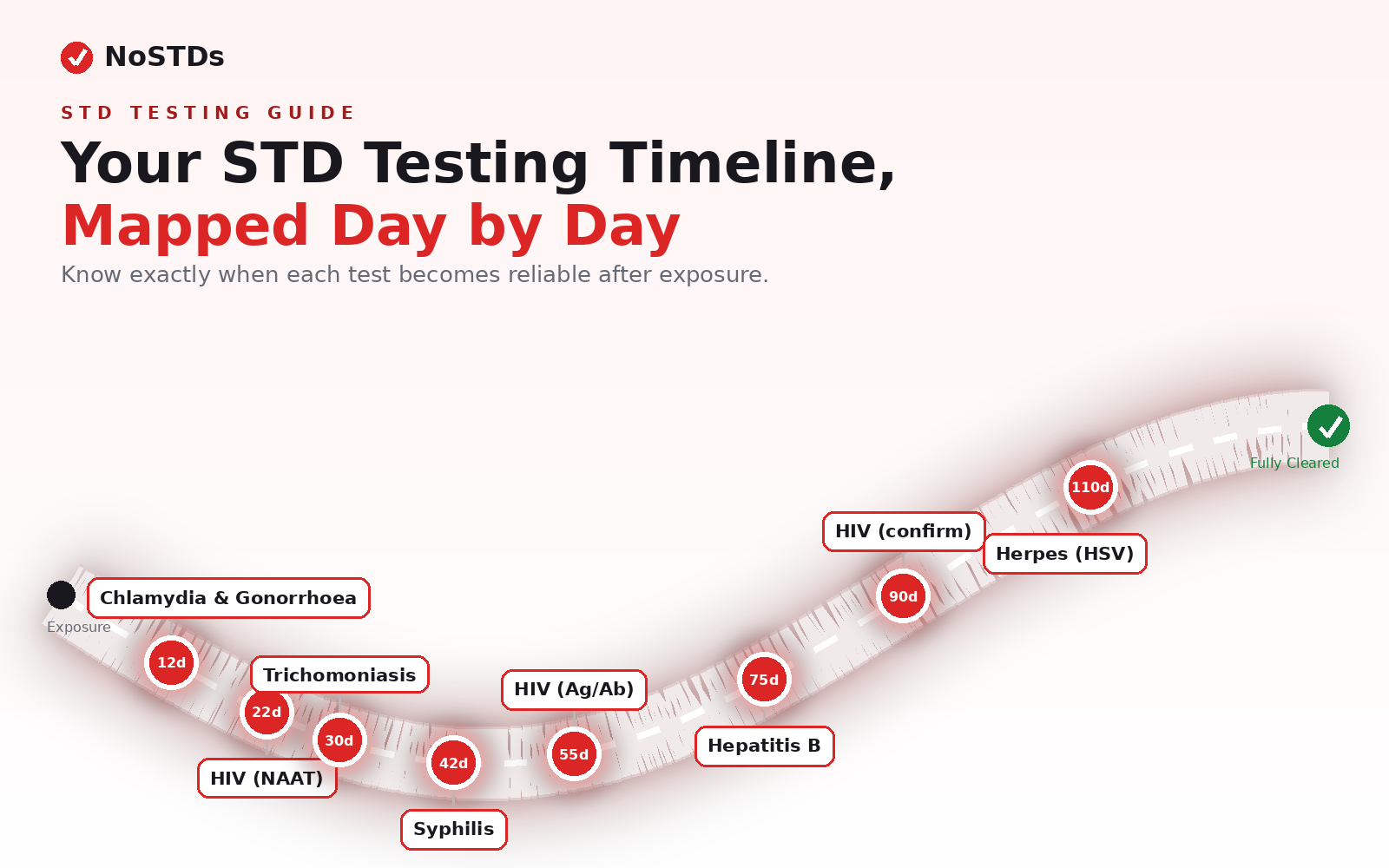
The question isn't simply "should I get tested" if you may have been exposed; it's also "when." If you test too soon, the infection hasn't reached detectable levels, so even a certified lab may give you a negative result that isn't true yet. This guide explains how to create a testing schedule you can truly rely on, how long to wait for each main STI, and what symptoms (if any) to anticipate and when
Why Window Periods Exist in the First Place:
- Antibody tests : Antibody tests, such as those for hepatitis, syphilis, HIV, and herpes, wait for your immune system to generate detectable antibodies. Your immune system must first identify the infection and then increase the production of antibodies to a level that the test can detect, which takes time. Regardless of how well the lab apparatus works, if you test too early, the antibodies just aren't there yet.
- NAAT tests :These windows are typically shorter because NAAT tests (used for chlamydia, gonorrhea, and trichomoniasis) identify the pathogen's genetic material; the bacteria or parasite must proliferate to a detectable level, which typically happens more quickly than a complete antibody response.
- Antigen tests (used in HIV 4th-generation testing) : Combined antigen/antibody tests can identify HIV earlier than antibody-only tests because antigen tests (used in HIV 4th-generation testing) search for a viral protein that appears before antibodies do.
These two terms get used interchangeably, but they measure different things — and mixing them up is one of the most common reasons people test too early.
- Incubation period — how long after exposure it takes for symptoms to potentially appear, if they appear at all
- Window period — how long after exposure it takes for a test to reliably detect the infection
For several common STIs, especially chlamydia, gonorrhea, and HIV, most people never notice symptoms at all — which means the window period, not how you feel, is the only number that actually matters for deciding when to test.
Factors That Can Shift Your Personal Window
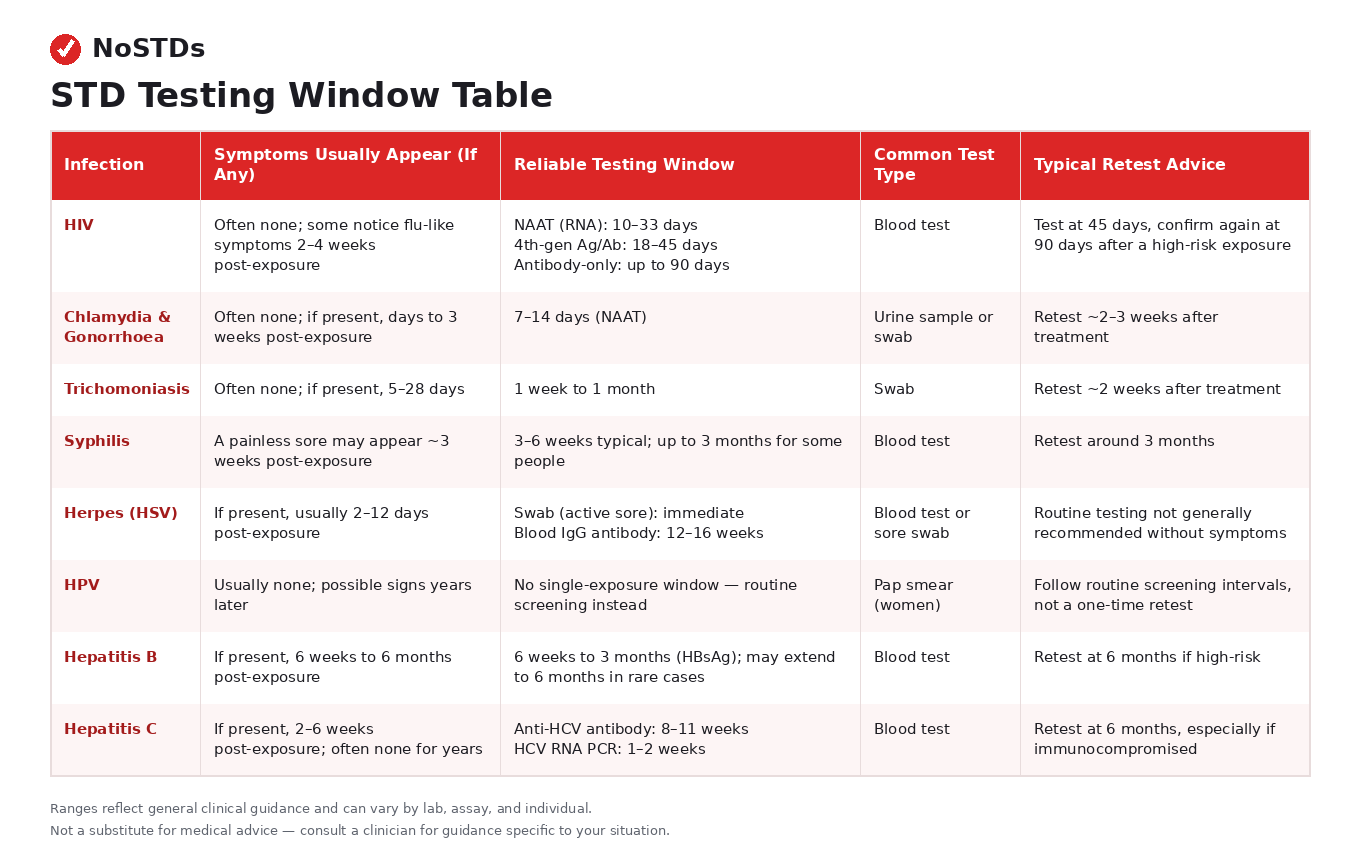
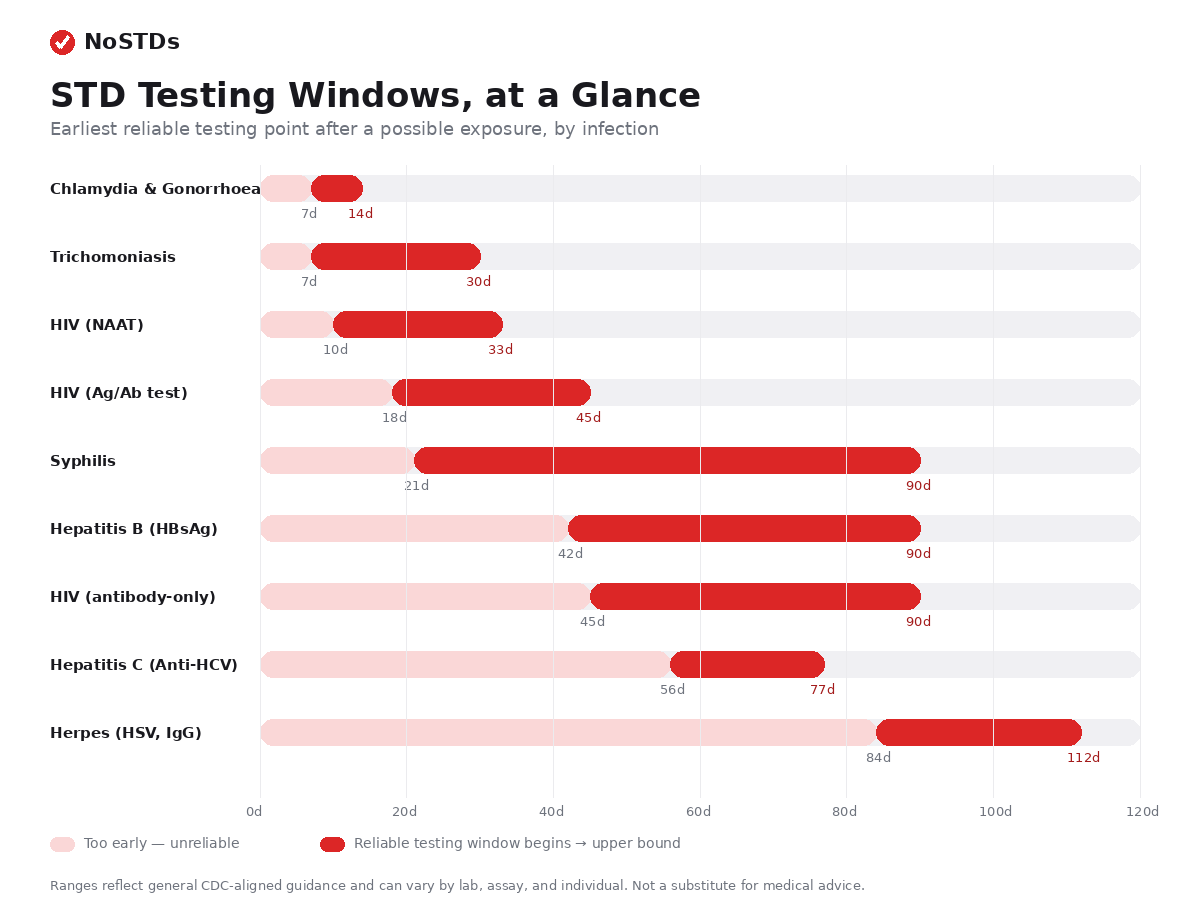
The ranges above are general guidance, not guarantees — several real factors can push your own window slightly earlier or later than the average:
- Test generation and lab quality -Infections are detected earlier by newer-generation tests (such as fourth-generation HIV testing) than by older versions of the same test. Current-generation tests are generally used by NABL-accredited labs, although it's best to confirm rather than assume.
- Test generation and lab quality - Test generation and lab quality: More recent tests, such as fourth-generation HIV tests, are able to identify infections earlier than their predecessors. NABL-accredited labs generally use current-generation tests, although it's best to confirm rather than assume.
- Individual immune response - Individual immune response: Hepatitis C windows can sometimes last up to six months because some patients, especially those with impaired immune systems, develop detectable antibodies more quickly or more slowly than others.
- Site of exposure - Infections such as gonorrhoea and chlamydia can arise not just genitally but also in the throat or rectum; a conventional urine test will not detect an infection at a different site. To ensure that the right swab location is examined, clearly state if oral or anal contact was a part of your exposure.
- Exposure intensity - Although this isn't dependable enough to schedule a testing date around, a higher-exposure encounter can occasionally result in somewhat faster detectability.
- Prior vaccination - In the case of hepatitis B in particular, a vaccinated person's antibody test may indicate immunity rather than active infection, which completely alters the picture. Mention your vaccination history prior to testing to ensure accurate interpretation of the results.
What Happens If You Test Too Early:
A negative result obtained prior to the conclusion of the window period is incomplete rather than incorrect. Since there wasn't enough of the virus, bacteria, or antibody to detect, the test really failed to locate what it was looking for. The true danger is in how that outcome is subsequently understood.
This is where a lot of needless worry—or needless risk to a partner—actually originates: not from the test itself, but rather from accepting an early negative as the definitive response. It makes sense to test early if you're nervous and need answers sooner; simply schedule the confirmatory test for the actual window from the beginning instead of viewing the early result as the end of the procedure.
A Closer Look at Each Infection
HIV
Chlamydia and Gonorrhea
Both are usually tested with the same type of sample (urine or a swab) and both become detectable within roughly 1–2 weeks. Because symptoms are frequently absent, a negative test at the 1-week mark is worth confirming with a second test a couple of weeks later if your risk continues.
Trichomonas
Detectable in a week to a month. Many people never have any symptoms, but when they do, they usually appear within a similar range of time (5–28 days).
Syphilis
About three weeks after exposure, syphilis can cause a painless sore called a chancre, which is easy to overlook because it doesn't feel. A 3-month retest is typically advised if the initial test was performed early since blood testing reaches full reliability by 6–12 weeks.
Herpes (HSV)
HPV
Hepatitis B and C
What to Do After a High-Risk Exposure
For other STIs, a reasonable general approach is:
- Test at 2 weeks for gonorrhoea and chlamydia, since these have the shortest reliable windows
- Test again at 6 weeks for a broader panel
- If everything is negative at 6 weeks and you're still concerned, repeat at 3 months specifically for HIV and syphilis, since these two need the longest runway to be fully conclusive
Why "No Symptoms" Doesn't Mean "No Infection"
Building Your Own Testing Timeline After an Exposure
If you're dealing with one specific exposure rather than routine screening, here's a practical way to sequence your testing rather than guessing at a single date:
- Day 1 (exposure date) — note it down. This becomes the anchor date for every window calculation. If there's any chance of a second, more recent exposure, restart the clock from that date instead.
- 72-hour mark — decide on PEP if relevant. If the exposure was high-risk for HIV, this is a time-sensitive window for post-exposure prophylaxis, separate from testing. Don't wait for a test result to make this decision.
- 1–2 week mark — test for chlamydia, gonorrhea, and trichomoniasis. These have the shortest reliable windows and are worth ruling out early, especially since they're both common and easily treatable.
- 3–6 week mark — test for early HIV (antigen/antibody) and early syphilis. A negative here is meaningful but not final for these two.
- 12 week mark — confirmatory panel. This is your most conclusive checkpoint for HIV, syphilis, and hepatitis B. If everything's been negative up to this point and stays negative here, you can reasonably consider yourself clear for these infections, barring any new exposure since.
- 12–16 week mark — herpes testing, only if clinically indicated. Not a routine step for most people, but relevant if you have symptoms or specific concerns.
This staged approach avoids the two most common mistakes: testing once too early and assuming it's final, or waiting the full 12 weeks for everything and missing an earlier opportunity to catch and treat a bacterial infection sooner.
Frequently Asked Questions
Can I trust a test taken the day after a possible exposure?
Generally no — every infection above needs at least several days, and most need weeks, before a test becomes reliable. An early negative result mainly tells you the test worked, not that you're clear.
What if I have symptoms already?
Symptoms can prompt earlier, more targeted testing — mention them to whoever is testing you, since it may change which tests they recommend and how urgently.
Do I need to retest after treatment?
For curable bacterial infections like chlamydia, gonorrhea, and trichomoniasis, yes — a retest a few weeks after treatment confirms the infection actually cleared.
I'm scared to find out. What should I do?
That's a completely normal reaction, and it's worth remembering that most STIs are manageable or fully curable with prompt treatment, while an untreated infection is what actually causes long-term harm. Testing is the step that gives you options — avoiding it doesn't make the risk disappear, it just delays finding out.
Can stress or anxiety affect my test result?
No — stress doesn't create a false positive or false negative on any of these tests. What stress can affect is whether someone tests at all, or whether they interpret an early result correctly, which is really a timing issue rather than the test itself being unreliable.
If my partner tested negative, do I still need to test?
Yes, generally — a partner's negative result only tells you about their status at the time they tested, using whatever window applied to their exposure history, not yours. Each person's testing timeline depends on their own most recent exposure.
Free and Low-Cost Testing Options in India
- ICTC (Integrated Counselling and Testing Centres), run under NACO's national network, provide free HIV testing and counselling across India — over 700 centres nationwide, typically attached to government hospitals and district health facilities.
- Government district hospitals increasingly offer broader STI panels beyond just HIV, often at no or minimal cost, though availability varies by state and facility.
- Private diagnostic labs in cities like Mumbai, Delhi, Bengaluru, Hyderabad, and Chennai offer comprehensive STI panels with same-day or next-day results, for those who want faster turnaround or additional privacy compared to a public facility.
Ready to verify your status?
Create a free account and take control of how you share your sexual health status.
Get started — it's free